TRACE-GS: On-Policy Trajectory Distillation with Privileged Geometric Conditioning for Sparse-View 3DGS Restoration

arXiv 2026

1Concordia University   2Mila – Quebec AI Institute   3Shanghai Jiao Tong University

Corresponding authors

Code coming soon.

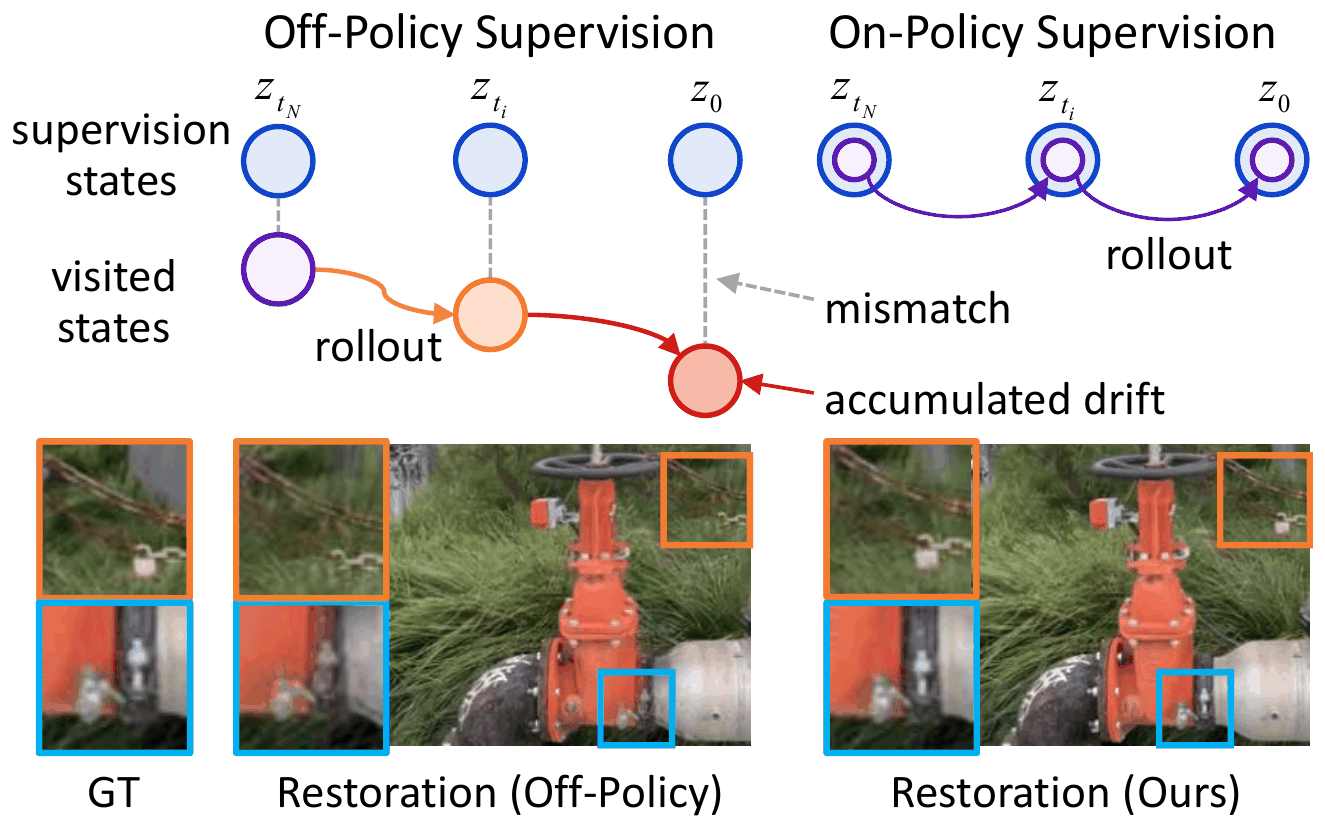
Off-policy mismatch in sparse-view 3DGS restoration
Off-policy mismatch in sparse-view 3DGS restoration. Top: supervision at independently forward-noised states misses the states the model actually visits during inference, letting deviations accumulate; on-policy supervision covers visited states. Bottom: on-policy restoration recovers sharper detail from 6 views.

Abstract

We present TRACE-GS, an on-policy trajectory distillation framework that leverages privileged geometric conditioning at training time, thereby adapting a diffusion prior to sparse-view 3D Gaussian Splatting (3DGS) restoration. Rather than pursuing increasingly sophisticated restoration architectures, we identify a more fundamental limitation shared by existing diffusion-based approaches: supervision at independently noised states does not cover those reached during inference. In sparse-view 3DGS, under-constrained geometry biases denoising from the outset, and the resulting deviations compound along the rollout. TRACE-GS instead performs on-policy trajectory distillation: a teacher conditioned on richer geometry from additional training views supplies targets along the sparse-view student's own rollout, aligning denoising directions and cross-view responses at each visited state. This training-only geometry places TRACE-GS in the learning using privileged information (LUPI) setting. At deployment, only the sparse-view student is retained, and its restored renderings serve as pseudo-observations for 3DGS refinement. To the best of our knowledge, TRACE-GS is the first to derive on-policy supervision from privileged geometry for sparse-view 3DGS restoration, achieving consistent gains and strong generalization across datasets and sparse-view settings.

Method
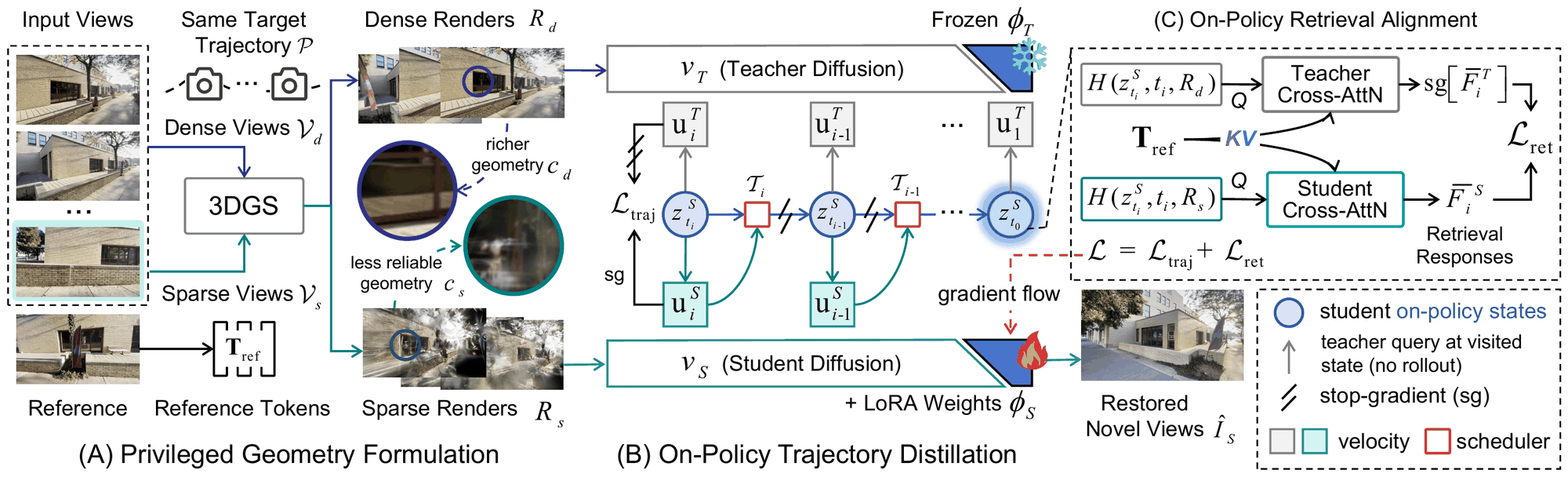
Overview of the TRACE-GS framework
Overview of TRACE-GS. (A) Given sparse views contained in dense views, we independently reconstruct a 3DGS from each view set and render paired sequences along the same target trajectory. (B) Built on the same frozen video-diffusion backbone, the teacher and student use a frozen and a trainable LoRA cloned from a shared initialization, forming a geometry-asymmetric pair. The student rolls out its reverse trajectory, while the teacher is queried at the same student-visited states without its own rollout. (C) At these states, one loss aligns velocity predictions and another aligns cross-view retrieval responses. Only the student LoRA is updated and retained for deployment.

Results

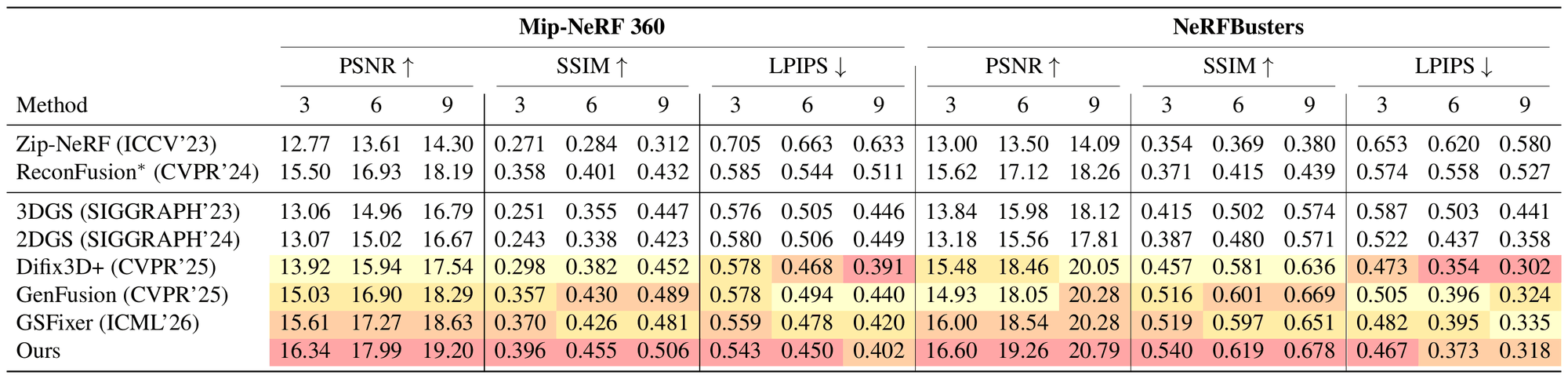
Quantitative comparison on Mip-NeRF 360 and NeRFBusters
Quantitative comparison on out-of-domain datasets. Evaluated on Mip-NeRF 360 and NeRFBusters under 3, 6, and 9 views. TRACE-GS achieves the best PSNR and SSIM at every sparsity level on both datasets, outperforming GSFixer by 0.73 dB on Mip-NeRF 360 and 0.60 dB on NeRFBusters under 3 views.
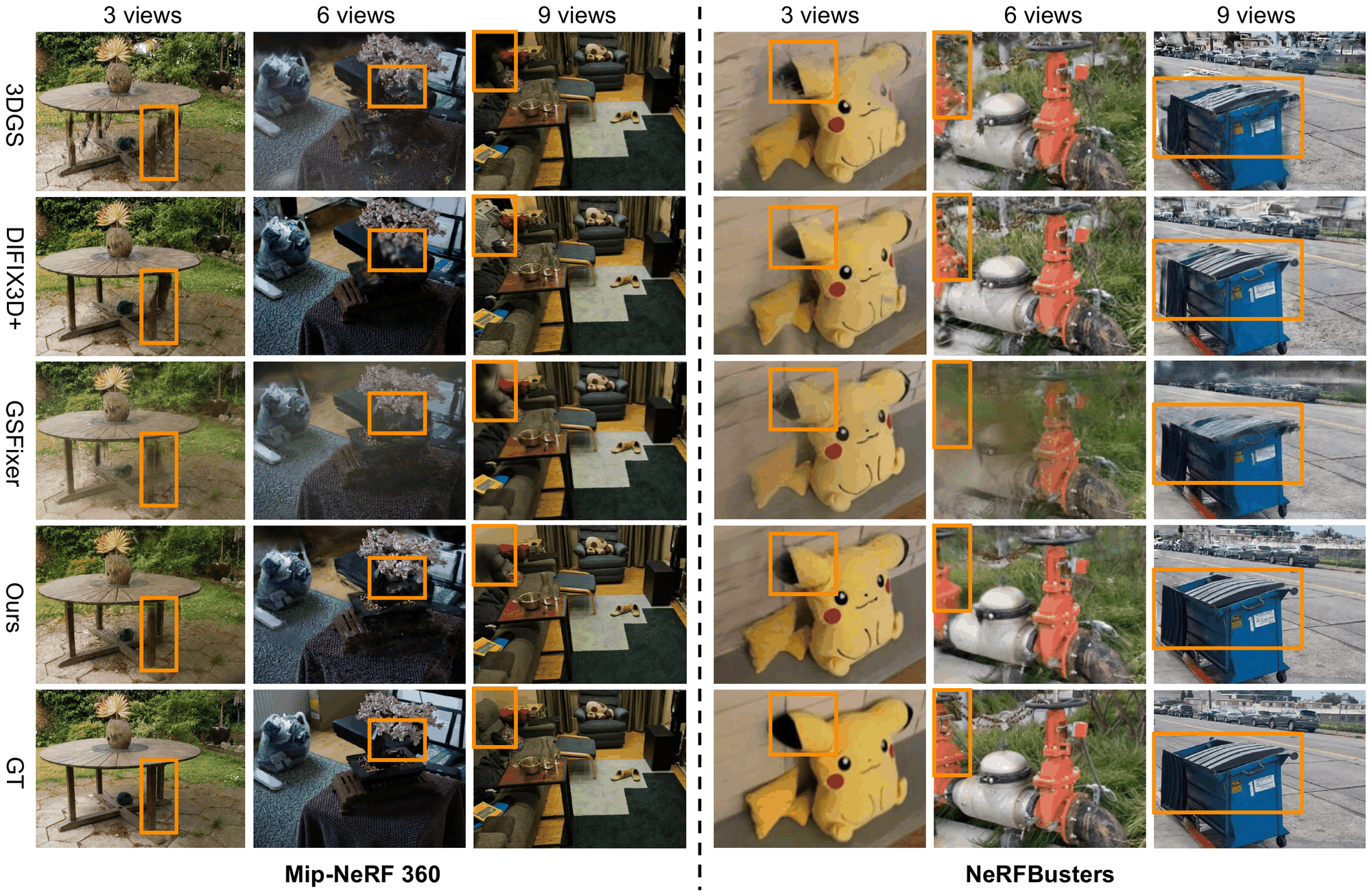
Qualitative comparison on Mip-NeRF 360 and NeRFBusters
Qualitative comparison on out-of-domain sparse-view reconstruction using 3, 6, and 9 views on Mip-NeRF 360 (left) and NeRFBusters (right). Orange boxes mark compared regions. Baseline failures shift from broken coarse geometry at 3 views to oversmoothed detail at denser settings, while TRACE-GS preserves both.

BibTeX

@article{jiang2026tracegs,
  title={TRACE-GS: On-Policy Trajectory Distillation with Privileged Geometric Conditioning for Sparse-View 3DGS Restoration},
  author={Jiang, Linlian and Xi, Yuchen and Pinon, Sadman Rakib and Yang, Ruigang and Wang, Yang and Zuo, Xinxin},
  journal={arXiv preprint arXiv:2608.10286},
  year={2026}
}